|
 |
 |
 |
 |
 |
 |
 |
 |
 |
 |
 |
 |
 |
Violence and Human Rights Question in BahrainHasan Moosa Shafaei
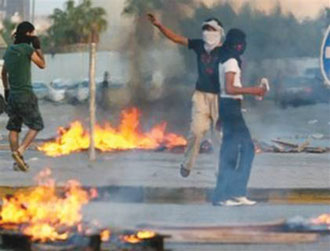
Reiterating what has previously been mentioned in other articles, violence and riots themselves represent a human rights violation, and provide a suitable environment for violating the laws and human rights standards. It may be useful to mention that most human rights violations in Bahrain revolve around the use of violence and riots and failure to abide by the law. At the same time, according to the Government, there is not a single political prisoner in Bahraini prisons. However, there are no more than 30 detainees who are classified by international organization as prisoners of conscience, affiliated to political groups or labeled as human rights activists. On the other hand, the Government says that these individuals were detained on security and not political grounds, for all of them and without exception, were found to have assembled illegally. They are also accused of participating in incidents of violence and riots such as burning tires, blocking streets, and vandalizing public and private properties, in addition to using incendiary bombs against security forces, endangering the security of the citizens among other accusations which result in the loss of innocent lives, injuries and financial loss. Moreover, all the after arrest allegations of human rights violations are in fact a result of breaching the law and involve violence. Some people claim that innocents have been arrested, subjected to torture and have not been provided with a fair trial. This comes within the context of the main issue which is street confrontations with violent and rioting youths. No persons have been arrested because they protested or because they expressed their opinions through various legal means. On the other hand, no persons were prevented from taking part in a demonstration, or denied their legal rights of peaceful assembly. . There are street confrontations between security forces and rioters who continue on a daily basis to burn tires, block roads and attack police cars with incendiary bombs. This is the real backdrop against which the issue of human rights has been discussed. Ironically, some staff members from international organizations witnessed the violence unfolding when they accompanied violence advocates to witnessing the events under the slogan ‘people’s struggle on the ground.’ In order to explain the violence, the Government itself also showed visiting officials from international organizations videotape recordings of the clashes, and how the security forces attempted to control the situation and defend themselves against incendiary bombs and locally made weapons.
A new case has arisen as a result of the violence which continued through the night. On 14 March 2010 in Karzacan, masked youths began blocking the roads with burnt tires, burning rubbish bins, and throwing Molotov cocktails at the security forces usually present in the area to open blocked roads for citizens, protect their interests and keep the peace. The security forces then used loudspeakers to call upon the youths to stop and go back to their houses, but to no avail. The rioters then began to heavily throw incendiary bombs at the police which hit a nearby police car. The police then retaliated by shooting live ammunition in the air as a warning, but the rioters did not stop, so they used the shozin weapon to disperse the crowds and to save the policemen inside the car. As a result, one of the rioters, named Hussain Ali Hassan Al Sahlawi sustained injuries to his body, but was able to flee with the others. The incident escalated later on when Al Sahlawi was taken by his friends for treatment, not to the hospital, but to the house of one of the nurses named Ibrahim Damistani in the village of Al Draz. Al Sahlawi was then taken to the central hospital in Sulaymaniya, where Damistani works. He received treatment there without any record or details of the patient and was then smuggled outside the hospital. When his condition deteriorated, Damistani returned him to the same hospital on 16 March 2010, and asked another nurse named Abdulaziz Shabeeb to take X-rays of the patient in order to remove debris from his body. Once again, the patient was smuggled out of the hospital without any records, as required by the law. The incident developed further when the Public Prosecutor detained both nurses for one day, and the Ministry of Health banned a scheduled meeting in solidarity with them. For this reason, the two nurses received more attention than Al Sahlawi himself. A number of international human rights organizations issued statements condemning the detention of Shabeeb and Damistani and the banning of the meeting. According to the information received by these organizations, Sahlawi was not involved in the violence that day, and was leaving his grandfather’s house, situated in the same area. Coincidentally, I was in Bahrain on a business trip and had an appointment with Police Major Rashid Mohammed bu Nijma, the Director of Legal Affairs, and a member of the Human Rights Committee at the Ministry of Interior. The meeting was scheduled to discuss issues related to human rights, including the recent incidents in Karzacan. Based on the available information, I could say the following:
Firstly, Hussain Al Sahlawi was one of the masked rioters in the violence which took place in the night of 14 March 2010, so he was not an innocent visitor to his grandfather as he claimed. The fact that he did not go directly to the hospital, or the police station to file a complaint, confirms this fact. Secondly, with regards to the detention of the two nurses and their interrogation by the Public Prosecutor, it is obvious that they violated the laws and regulations of the Ministry of Health in failing to record the medical details of the patient, and hiding him from the law. The issue is not that they provided him with humanitarian medical assistance, as this obviously not a crime. Thirdly, with regards to the banning of the Nursing Society’s meeting and even changing the door locks to achieve this, this is an unjustifiable action, and contradicts Bahrain’s democracy and human rights standards. Whatever the reason was and whoever made the decision, it was a wrong one which harms the reputation of Bahrain and its reform experience, and strongly contradicts the King’s reform project and public freedoms. Fourthly, there are some organizations such as Amnesty International who regarded the use of Shozin as an excessive use of force. We believe that the security forces have displayed a considerable amount of self restraint and that confrontations with rioting youths are far from being confrontations with peaceful individuals, rather there was a real threat to their lives. Proof of this lies in the number of innocent citizens who have been killed or injured. Additionally, during the same period, the citizen Jaffer Makki Salman was attacked with an incendiary bomb, sustaining burns in his back and neck while in his car and was saved by some passers-by and the police. In other words, rioting is in essence violent and dangerous, and only the police can assess the magnitude of this danger. However, the security forces should provide evidence of being targets of assault, and prove that their retaliation with live ammunition was a necessary form of self defence and was used to protect innocent lives. We are certain that violence and riots escalate when Bahrain is under the spotlight. As Amnesty International stated, this recent incident came when Bahrain was hosting the Formula 1 races, and Karazcan village is close to the place where the races were launched. We re-stress that violence is a constant source of human rights violations as well as many debates on human rights issues. This reveals the fact that violence represents a barrier against positive and constant developments in the human rights situation. Unfortunately, such developments go unnoticed, as violence and its repercussions are the ones which grab the headlines. |